Frequency reproducibility of solid-state thorium-229 nuclear clocks
TL;DR
This study characterizes the frequency reproducibility of solid-state thorium-229 nuclear clocks in CaF2 crystals, identifying optimal conditions for stable operation. Key findings include a concentration-dependent linewidth and a temperature of 196 K where thermal sensitivity vanishes, enabling high precision.
Key Takeaways
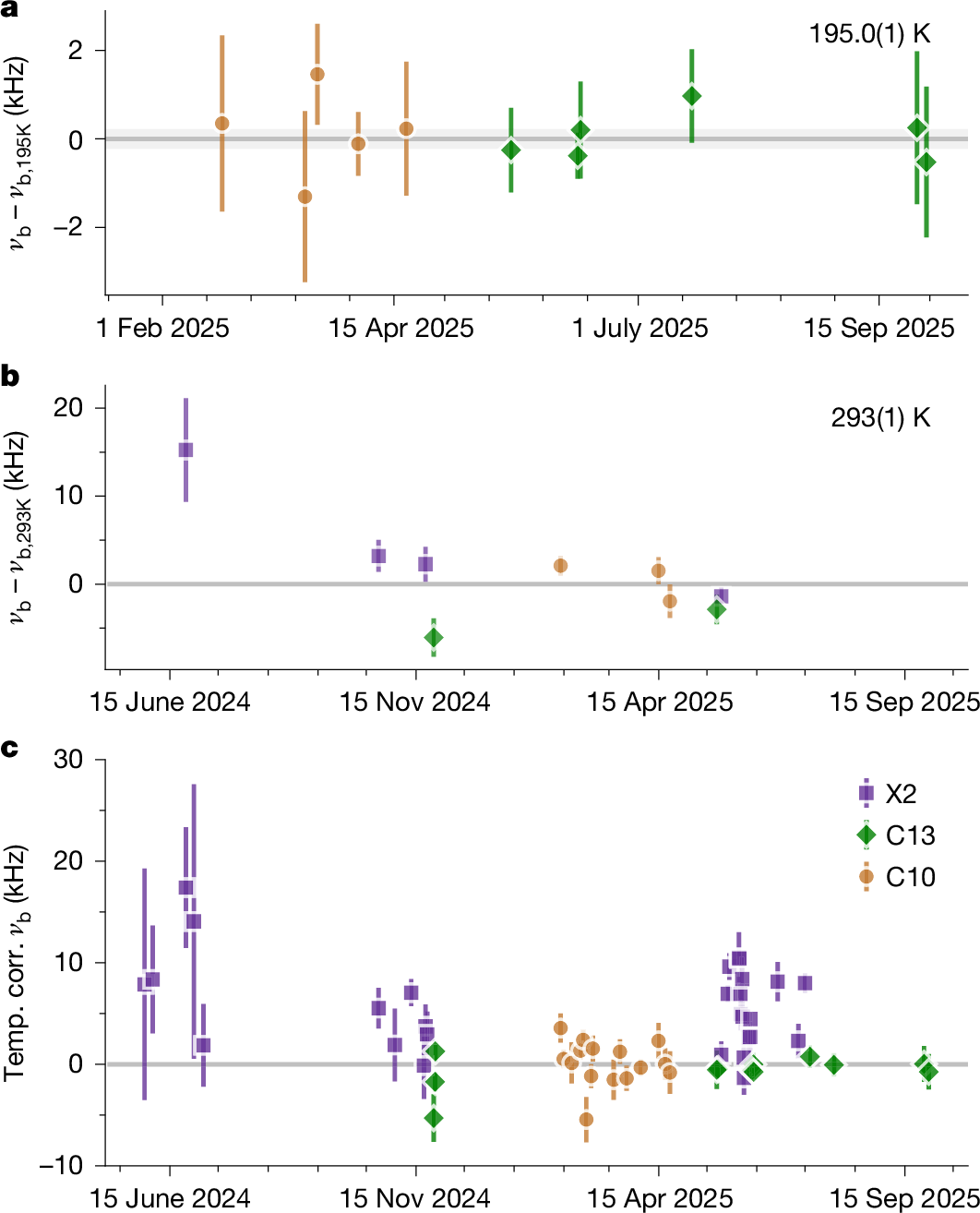
- •The frequency reproducibility of the 229Th:CaF2 nuclear clock transition is measured, showing a reproducibility of 220 Hz (1.1 × 10^-13 fractional) over 7 months at 195 K.
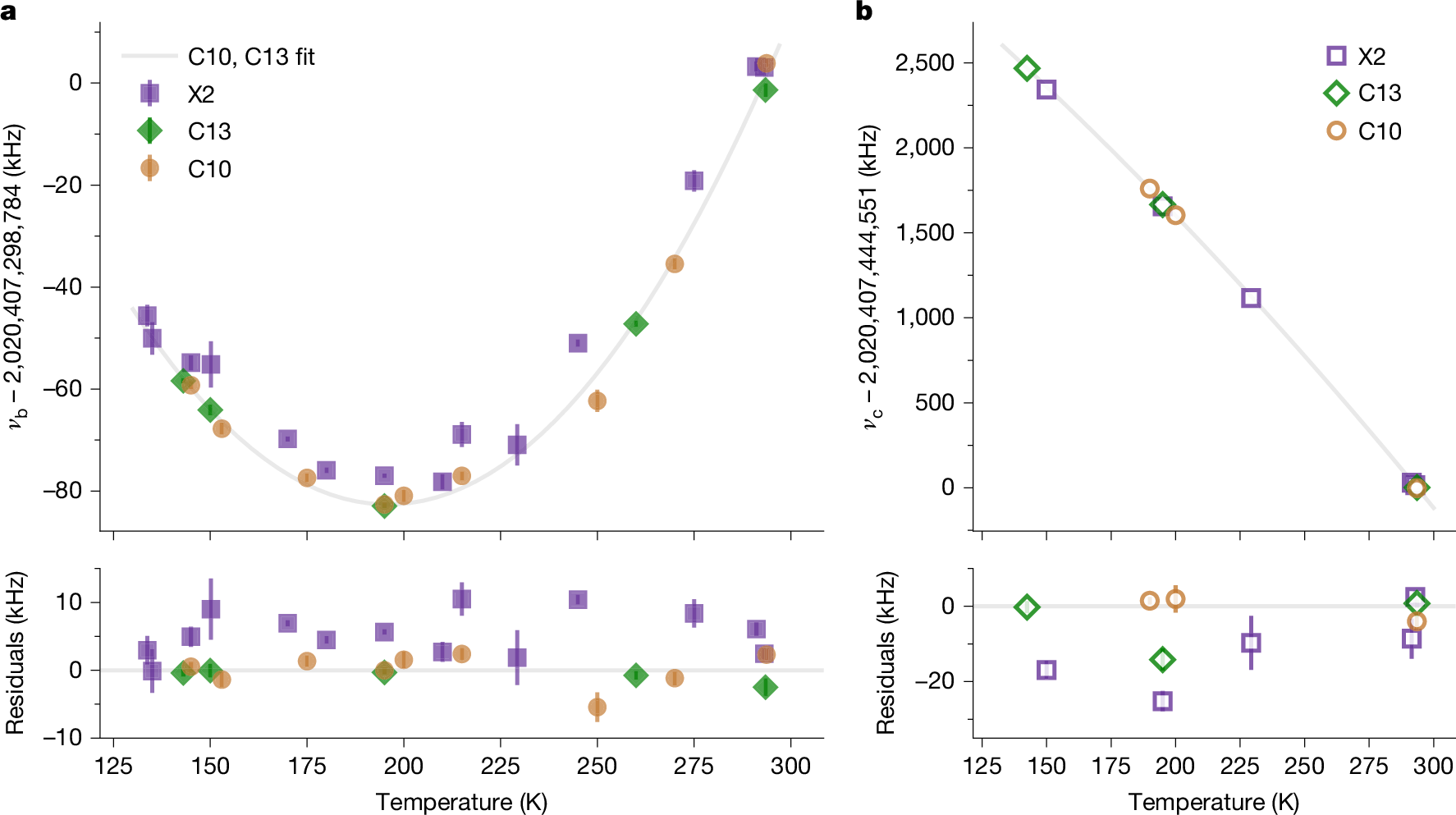
- •An optimal working temperature of 196(5) K is determined, where first-order thermal sensitivity vanishes, reducing temperature-induced shifts below 10^-18 fractional uncertainty.
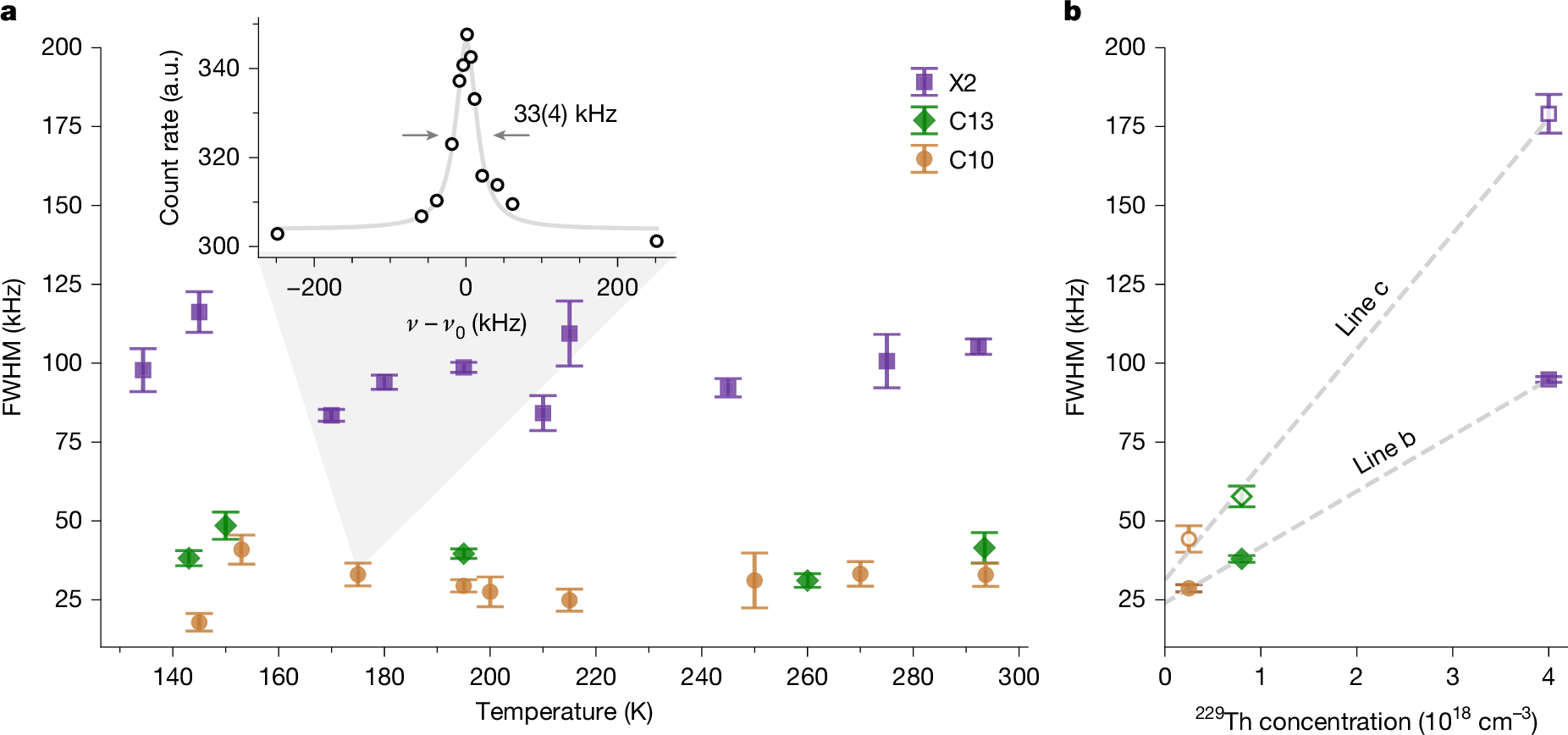
- •The inhomogeneous linewidth of the nuclear transition is concentration-dependent and limited by intrinsic host crystal properties, affecting clock performance.
- •Solid-state systems offer advantages like higher emitter density and simpler thermal control, making them suitable for compact, field-deployable clocks.
- •Results support applications in precision metrology and fundamental physics, such as constraining variations of fundamental constants.
Tags
Abstract
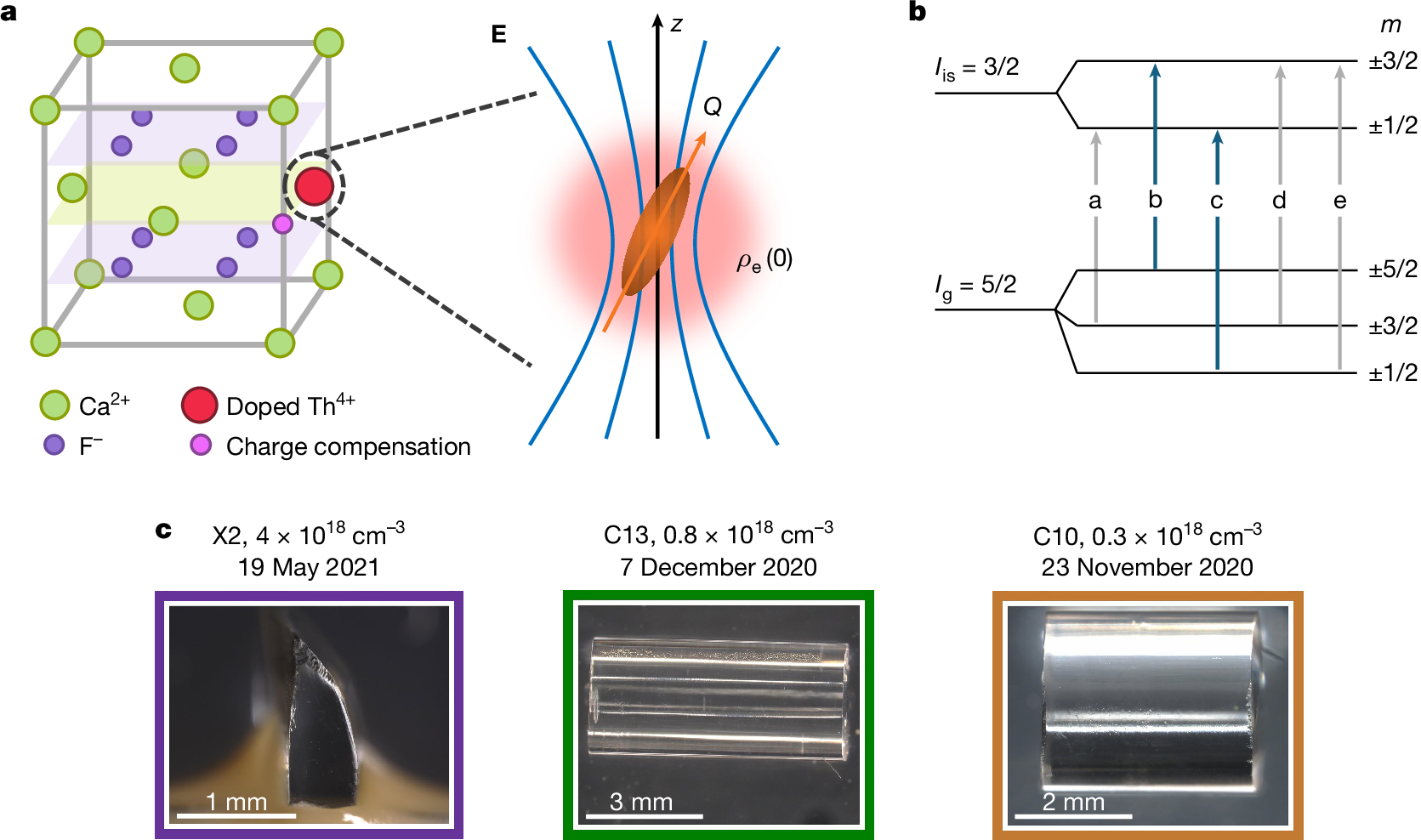
Solid-state thorium-229 (229Th) nuclear clocks1,2,3,4,5 are set to provide new opportunities for precision metrology and fundamental physics6,7,8. Taking advantage of inherent low sensitivity of a nuclear transition to its environment9, orders of magnitude more emitters can be hosted in a solid-state crystal compared with current optical lattice atomic clocks10. Furthermore, solid-state systems needing only simple thermal control11 are key to the development of field-deployable compact clocks. Here we explore and characterize the frequency reproducibility of the 229Th:CaF2 nuclear clock transition, a key performance metric for all clocks. We measure the transition linewidth and centre frequency as a function of the doping concentration, temperature and time. We report the concentration-dependent inhomogeneous linewidth of the nuclear transition, limited by the intrinsic host crystal12 properties. We determine an optimal working temperature for the 229Th:CaF2 nuclear clock at 196(5) K, at which the first-order thermal sensitivity vanishes. This would enable in situ temperature co-sensing using different quadrupole-split lines, reducing the temperature-induced systematic shift below the 10−18 fractional frequency uncertainty level. At 195 K, the reproducibility of the nuclear transition frequency is 220 Hz (fractionally 1.1 × 10⁻¹³) for two differently doped 229Th:CaF2 crystals over 7 months. These results form the foundation for understanding, controlling and harnessing the coherent nuclear excitation of 229Th in solid-state hosts and for their applications in constraining temporal variations of fundamental constants.
Access Nature and 54 other Nature Portfolio journals
Get Nature+, our best-value online-access subscription
$32.99 / 30 days
cancel any time
Subscribe to this journal
Receive 51 print issues and online access
$199.00 per year
only $3.90 per issue
Buy this article
- Purchase on SpringerLink
- Instant access to the full article PDF.
USD 39.95
Prices may be subject to local taxes which are calculated during checkout
229ThF4 thin films for solid-state nuclear clocks
Frequency ratio of the 229mTh nuclear isomeric transition and the 87Sr atomic clock
Laser spectroscopy of triply charged 229Th isomer for a nuclear clock
Data availability
The datasets generated and analysed during this study are available at Zenodo67 (https://doi.org/10.5281/zenodo.15751158).
References
Tiedau, J. et al. Laser excitation of the Th-229 nucleus. Phys. Rev. Lett. 132, 182501 (2024).
Elwell, R. et al. Laser excitation of the 229Th nuclear isomeric transition in a solid-state host. Phys. Rev. Lett. 133, 013201 (2024).
Zhang, C. et al. Frequency ratio of the 229mTh nuclear isomeric transition and the 87Sr atomic clock. Nature 633, 63–70 (2024).