Bohmian mechanics remains unchallenged by tunnelling experiment
arising from: V. Sharoglazova et al. Nature https://doi.org/10.1038/s41586-025-09099-4 (2025).
In a recent work1, Sharoglazova et al. reported an experiment aimed at determining how fast quantum particles traverse a classically forbidden region, where motion is prohibited in classical physics but allowed by quantum tunnelling. They argue that the inferred energy–speed relation challenges Bohmian mechanics, which augments quantum theory with a law for particle velocities and trajectories. We show that this claim relies on idealizations that are inappropriate for the experiment’s dynamical regime and that, if taken seriously, would pose comparable problems for standard quantum mechanics. Once the time-dependent and dissipative features of the experiment are taken into account, the results are fully consistent with Bohmian mechanics.
Access Nature and 54 other Nature Portfolio journals
Get Nature+, our best-value online-access subscription
$32.99 / 30 days
cancel any time
Subscribe to this journal
Receive 52 print issues and online access
$199.00 per year
only $3.83 per issue
Buy this article
- Purchase on SpringerLink
- Instant access to the full article PDF.
USD 39.95
Prices may be subject to local taxes which are calculated during checkout
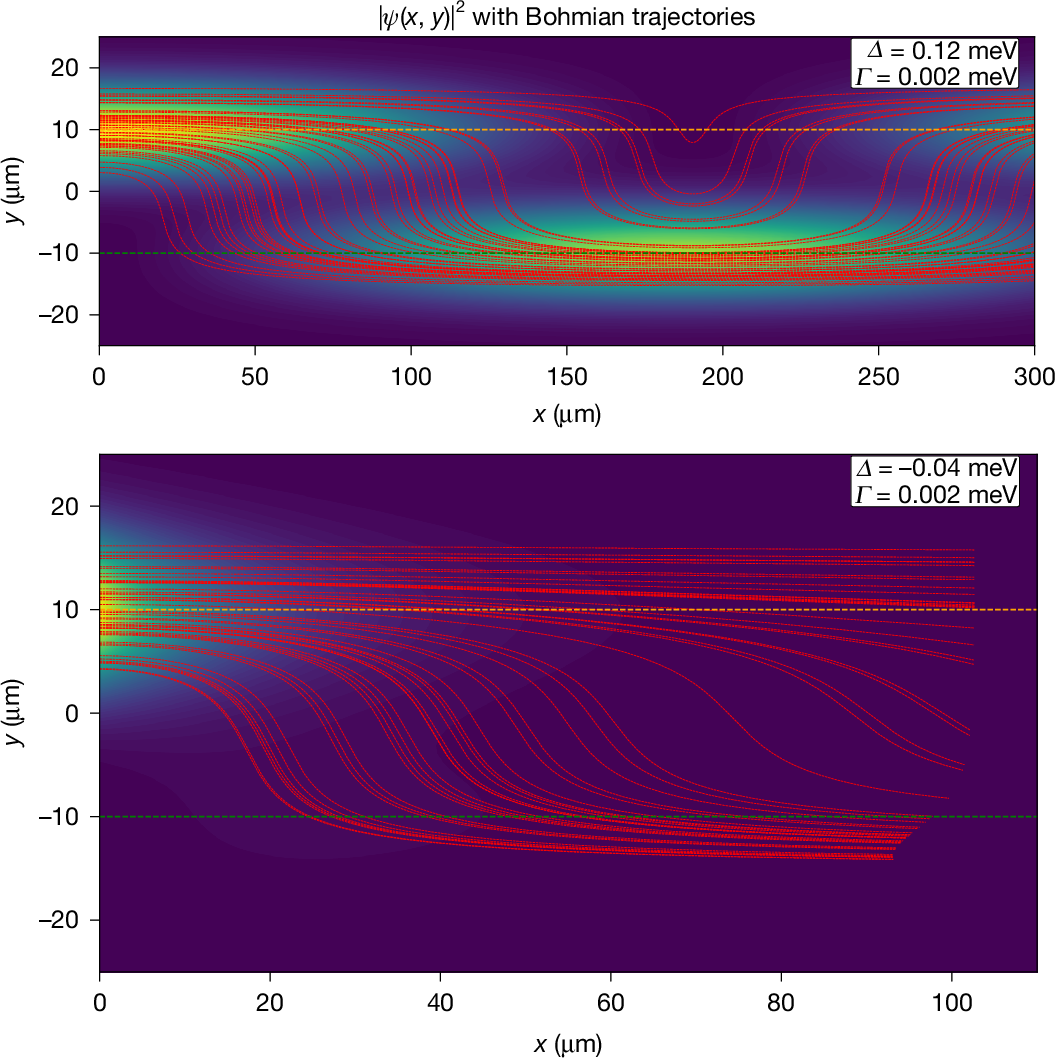 The alternative text for this image may have been generated using AI.
Data availability
No datasets were generated beyond the numerical values underlying the plot, which are available from the corresponding author upon request.
Code availability
The numerical code used to generate the plot in this work is available from the corresponding author upon request.
References
Sharoglazova, V., Puplauskis, M., Mattschas, C., Toebes, C. & Klaers, J. Energy–speed relationship of quantum particles challenges Bohmian mechanics. Nature 643, 67–72 (2025).
Dürr, D., Goldstein, S. & Zanghì, N. Quantum equilibrium and the origin of absolute uncertainty. J. Stat. Phys. 67, 843–907 (1992).
Dürr, D., Goldstein, S. & Zanghì, N. Quantum equilibrium and the role of operators as observables in quantum theory. J. Stat. Phys. 116, 959–1055 (2004).
Tumulka, R. On Bohmian mechanics, particle creation, and relativistic space-time: happy 100th birthday, David Bohm! Entropy 20, 462 (2018).
Sanz, A. S. & Miret-Artés, S. A Trajectory Description of Quantum Processes. I. Fundamentals: A Bohmian Perspective Lecture Notes in Physics Vol. 850 (Springer, 2012).
Longhi, S. Quantum-optical analogies using photonic structures. Laser Photon. Rev. 3, 243–261 (2009).
Nikolic, H. Overcoming a challenge for Bohmian mechanics. Preprint at http://arxiv.org/abs/2507.08049 (2025).
Wang, Y.-F., Wang, X.-Y., Wang, H. & Lu, C.-Y. Tunnelling photons pose no challenge to Bohmian mechanics. Preprint at https://arxiv.org/abs/2507.20101 (2025).
Leavens, C. R. Transmission, reflection and dwell times within Bohm’s causal interpretation of quantum mechanics. Solid State Commun. 74, 923–928 (1990).
Norsen, T. The pilot-wave perspective on quantum scattering and tunneling. Am. J. Phys. 81, 258–266 (2013).
Drezet, A. & Genet, C. Imaging surface plasmons: from leaky waves to far-field radiation. Phys. Rev. Lett. 110, 213901 (2013).
Drezet, A. et al. Leakage radiation microscopy of surface plasmon polaritons. Mater. Sci. Eng. B 149, 220–229 (2008).