Bulk hexagonal diamond
TL;DR
Researchers have successfully synthesized millimeter-sized, phase-pure hexagonal diamond (HD) from graphite under high pressure and temperature. This resolves the long-standing controversy over HD's existence and reveals it has slightly higher hardness and thermal stability than cubic diamond.
Key Takeaways
- •Hexagonal diamond (HD) was synthesized from graphite at high pressure and temperature, providing solid experimental evidence for its existence.
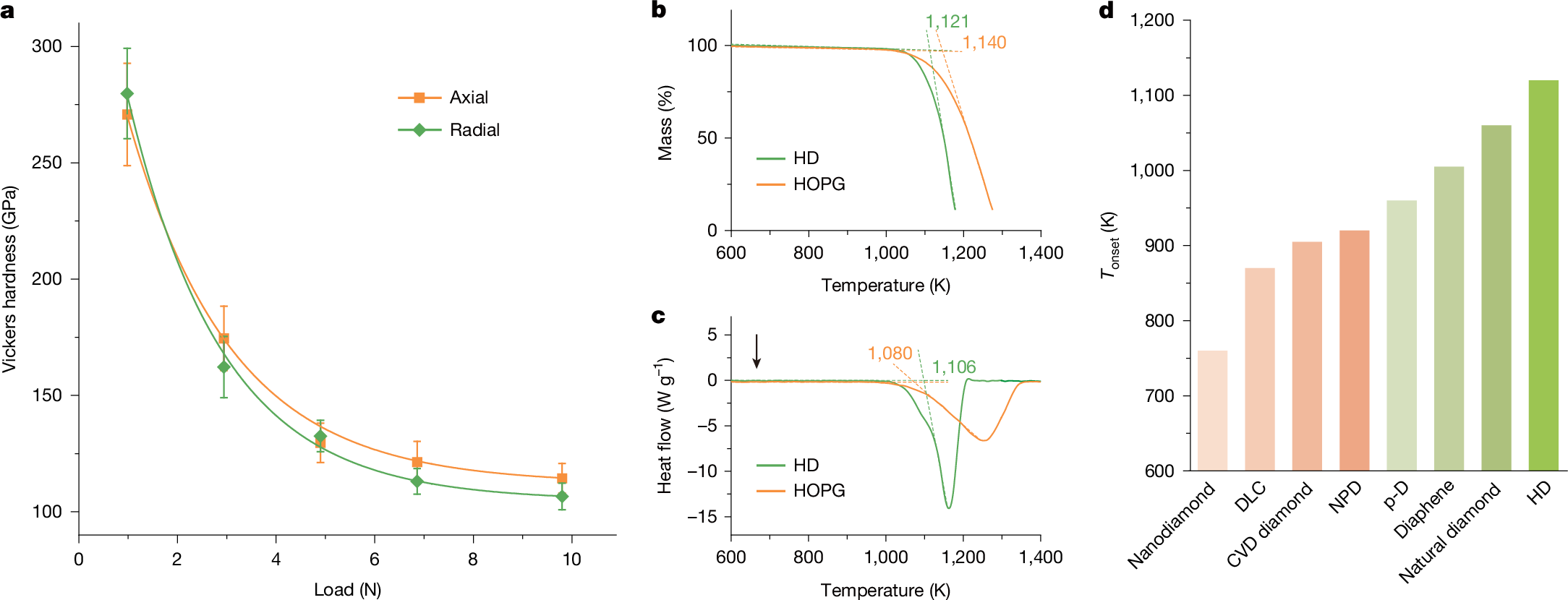
- •HD exhibits slightly higher hardness and high thermal stability compared to cubic diamond (CD).
- •The study clarifies the transformation pathway from graphite to HD, offering new insights into carbon phase transitions.
- •This breakthrough paves the way for future research and potential technological applications of HD.
Tags
Abstract
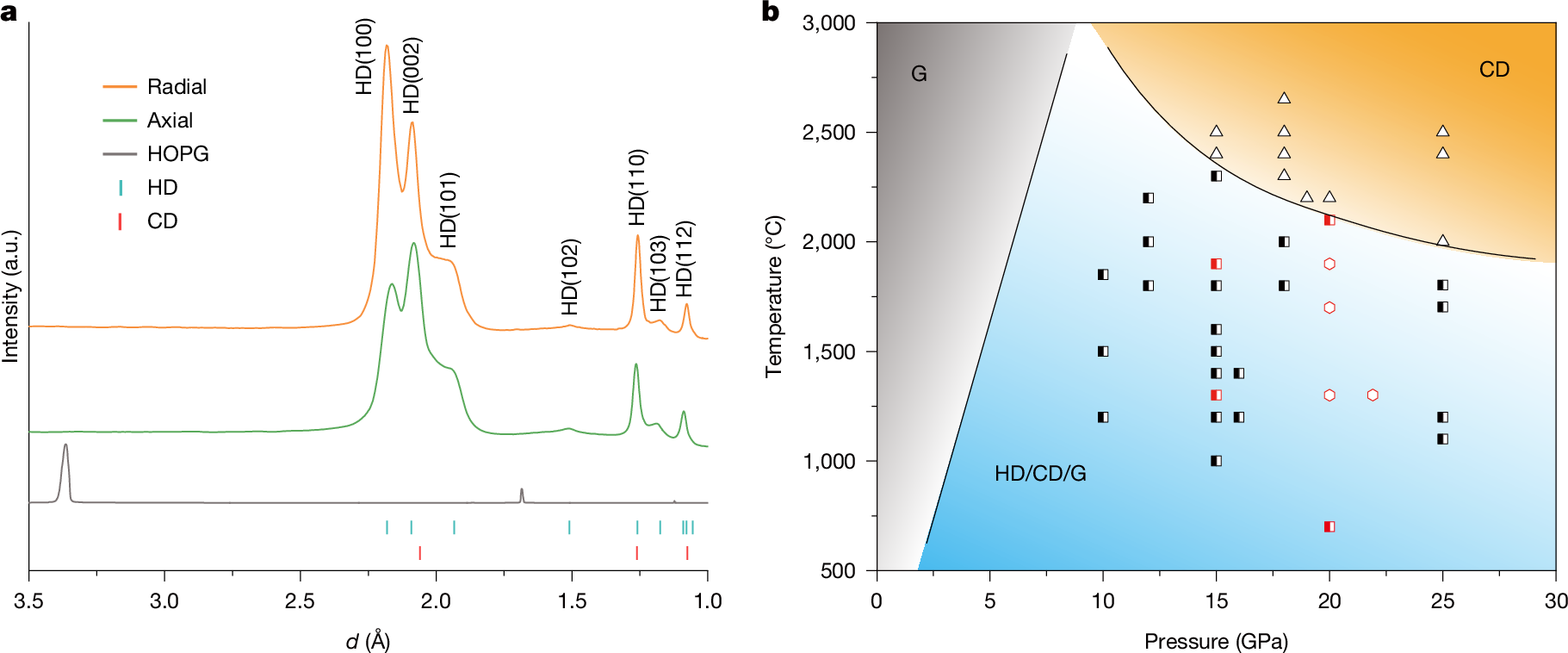
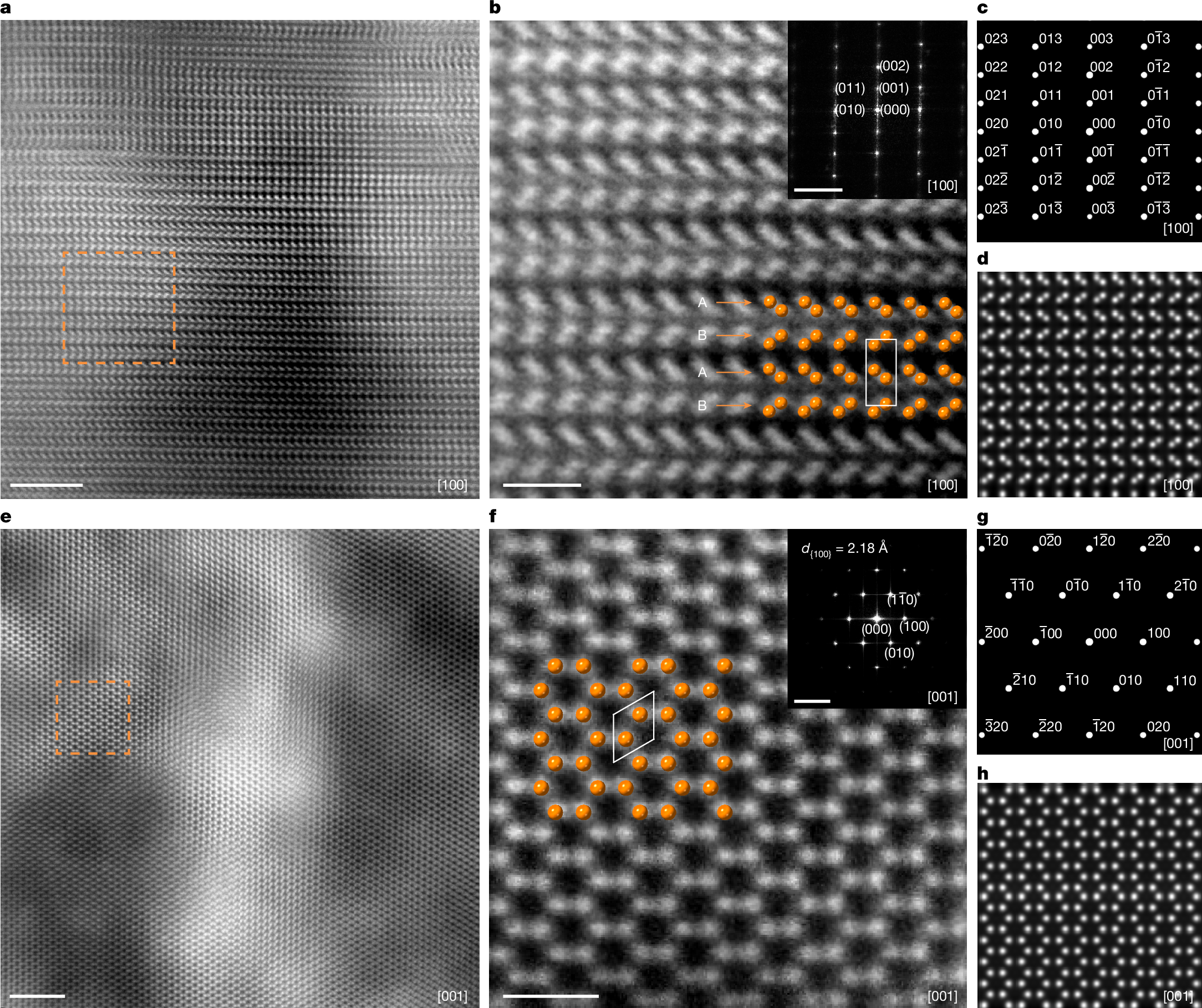
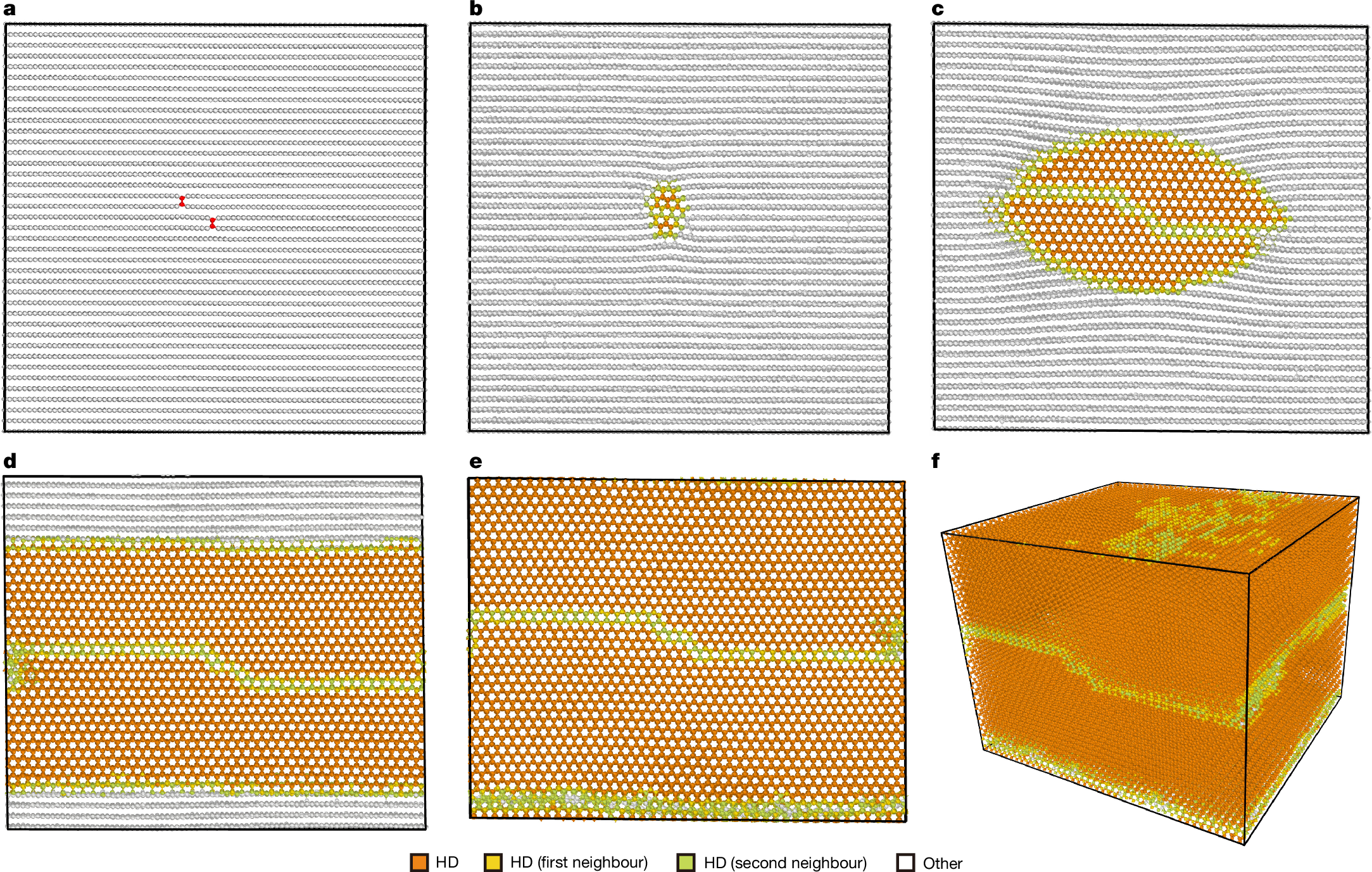
Known as the ‘ultimate semiconductor’, cubic diamond (CD) has gained substantial interest both scientifically and industrially. Its polymorph, hexagonal diamond (HD), is even more intriguing because of its fascinating properties associated with the meteorite impacts1,2,3,4,5,6,7,8. As no solid experimental evidence has been provided to prove its existence, the physical properties of HD remain largely unexplored. Here we report the synthesis of millimetre-sized, phase-pure HD from highly oriented pyrolytic graphite (HOPG) compressed along the c-axis at elevated temperatures. Combining advanced structural characterizations and theoretical simulations, we confirm the identity of HD and clarify the transformation pathway from graphite. Bulk HD exhibits a slightly higher hardness than CD and high thermal stability. These findings resolve the long-standing controversy on the existence of HD as a discrete carbon phase and provide new insight into the graphite-to-diamond phase transition, paving the way for future research and practical use of HD in advanced technological applications.
Access Nature and 54 other Nature Portfolio journals
Get Nature+, our best-value online-access subscription
$32.99 / 30 days
cancel any time
Subscribe to this journal
Receive 51 print issues and online access
$199.00 per year
only $3.90 per issue
Buy this article
- Purchase on SpringerLink
- Instant access to the full article PDF.
USD 39.95
Prices may be subject to local taxes which are calculated during checkout
Data availability
All data supporting the findings of this study are available within this article and its Supplementary Information. Source data are provided with this paper.
References
Ergun, S. & Alexander, L. E. Crystalline forms of carbon: a possible hexagonal polymorph of diamond. Nature 195, 765–767 (1962).
Bundy, F. P. & Kasper, J. S. Hexagonal diamond—a new form of carbon. J. Chem. Phys. 46, 3437–3446 (1967).
Frondel, C. & Marvin, U. B. Lonsdaleite, a hexagonal polymorph of diamond. Nature 214, 587–589 (1967).
Hanneman, R. E., Strong, H. M. & Bundy, F. P. Hexagonal diamonds in meteorites: implications. Science 155, 995–997 (1967).
Pan, Z., Sun, H., Zhang, Y. & Chen, C. Harder than diamond: superior indentation strength of wurtzite BN and lonsdaleite. Phys. Rev. Lett. 102, 055503 (2009).
Qingkun, L., Yi, S., Zhiyuan, L. & Yu, Z. Lonsdaleite – a material stronger and stiffer than diamond. Scr. Mater. 65, 229–232 (2011).
Israde-Alcántara, I. et al. Evidence from central Mexico supporting the Younger Dryas extraterrestrial impact hypothesis. Proc. Natl Acad. Sci. USA 109, E738–E747 (2012).
Tomkins, A. G. et al. Sequential lonsdaleite to diamond formation in ureilite meteorites via in situ chemical fluid/vapor deposition. Proc. Natl Acad. Sci. USA 119, e2208814119 (2022).